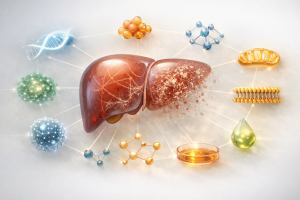

Chronic viral hepatitis is not only a fight against infection, but also a race against time. While antiviral therapy suppresses viral replication, the liver continues to scar. Fibrotic tissue builds up like a silent avalanche, squeezing healthy cells year after year and cutting off blood flow. And even when the virus is suppressed or completely eliminated, already formed scars remain, inexorably pushing the patient to cirrhosis and its complications-ascites, bleeding, liver failure.
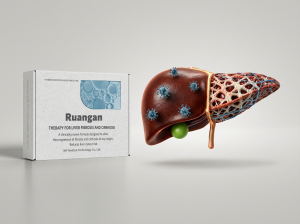
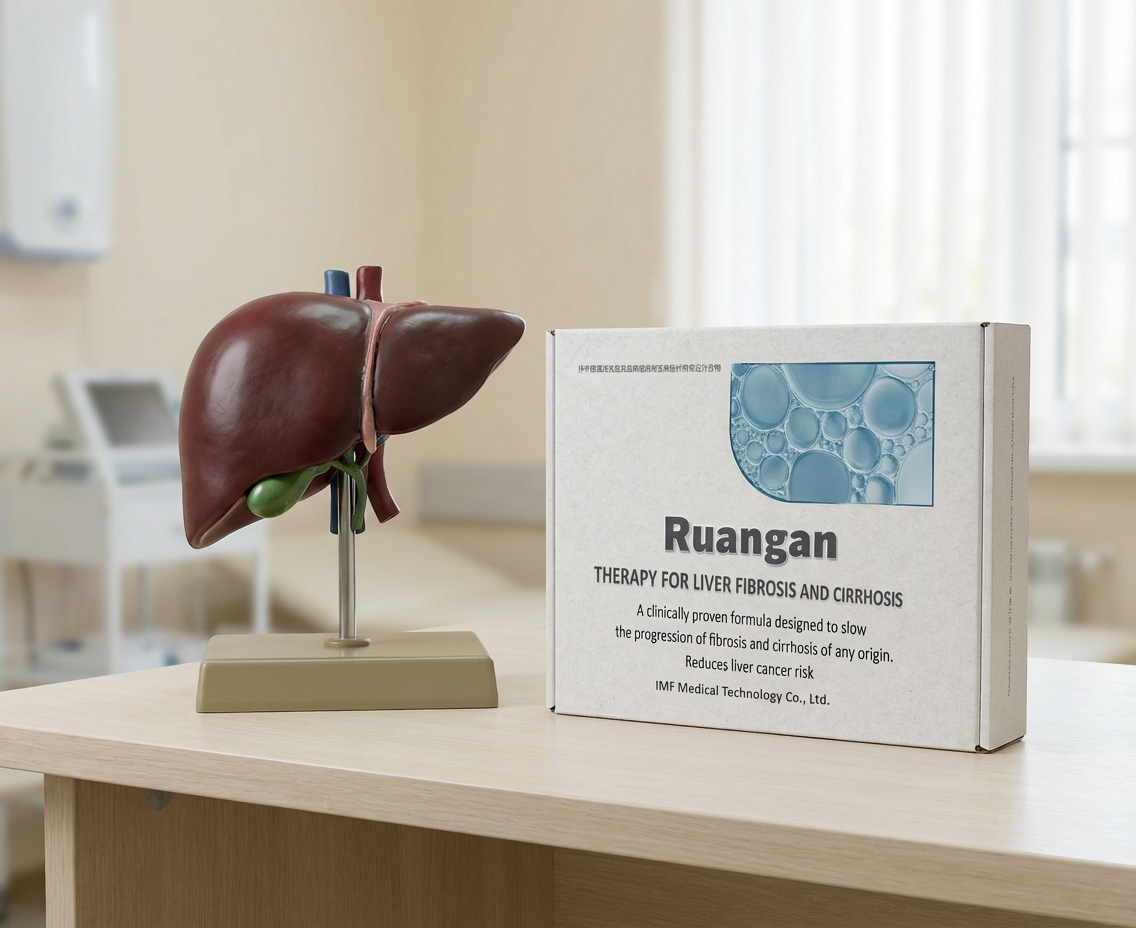
In this reality, a drug that can not just ‘protect’ the liver, but actively disassemble the pathological tissue, is critically important. Fufang Bijia Ruangan Pian (in granular form — Ruangan Granule) is the first officially registered drug with a proven ability to cause regression of liver fibrosis. This is not a hepatoprotector in the classical sense, but a full-fledged pathogenetic therapy tool that can change the prognosis of the disease.
Why is fibrosis the main threat in hepatitis B and D?
Hepatitis B (HBV) and especially hepatitis D (HDV, occurs only with B) are characterized by an aggressive course. Hepatitis D virus is a superinfection that accelerates the destruction of the liver at times. If isolated hepatitis B can take 15-20 years to develop cirrhosis, then coinfection with delta virus reduces this period to 5-7 years.
The problem is compounded by the fact that no effective drugs have been available for hepatitis D for a long time. Even with the advent of bulevirtide (Mircludex), a complete cure requires long-term therapy (48 weeks or more), and all this time fibrosis continues to progress. As a result, even after successful suppression of the virus, the patient may be left with cirrhosis — a condition that can no longer be completely cured and requires lifelong monitoring.
It is here that the value of drugs that can work with scar tissue in parallel with antiviral therapy is revealed.
What is Fufang Bijia Ruangan Pian?
It is a multicomponent preparation of traditional Chinese medicine (TCM), adapted to the standards of modern evidence-based pharmacology. The drug was developed in China specifically for the treatment of liver fibrosis and became the first in its class to receive official regulatory approval (NMPA) with a direct indication — slowing and reversing the development of fibrosis.
The composition of the drug includes 11 components:
- The shell of a soft-bodied turtle (Biejia) is the main active substance, known for the property of ‘softening hard’.
- Astragalus (Huangqi), Red Peony root (Chishao), Cordyceps-provide anti-inflammatory and immunomodulatory effects.
- Forsythia, Codonopsis, Panax notoginseng-improve microcirculation and metabolism in the liver.
Each component has been extracted and standardized, which guarantees the stability of the therapeutic effect.
Mechanism of action: Work on three levels
Unlike synthetic drugs that act on a single target, Ruangan implements a multi-target strategy, attacking fibrosis from different angles.
1. Suppression of liver stellate cells (HSC)
These are the main’ culprits ‘ of fibrosis. Normally, they sleep and store vitamin A, but when inflamed, they activate and turn into myofibroblasts-cells that produce non-stop collagen. Ruangan blocks their proliferation and even triggers their apoptosis (programmed death), clearing the liver of pathological elements.
2. Blockade of fibrogenesis signaling pathways
The drug inhibits the key pro-inflammatory pathway TGF-β1 / Smad, which is the command center that gives orders for the synthesis of scar tissue. By blocking signal transmission, Ruangan stops the production of excess collagen at the gene expression level.
3. Activation of matrix degradation
The drug increases the activity of matrix metalloproteinases — MMP) – enzymes that break down collagen. At the same time, it reduces the level of their inhibitors (TIMP), removing the ‘brakes’ from the process of cleaning the liver from fibrous septa.
Clinical evidence: Numbers that are impressive
Key research registered in ClinicalTrials.gov NCT01965418 included 240 patients with chronic hepatitis B and liver fibrosis. Participants were divided into two groups: one received only the antiviral drug (entecavir), the second — a combination of entecavir and Ruangan.
Results after 48 weeks of therapy:
| Indicator | Entecavir only | Entecavir + Ruangan | Significance (P) |
|---|---|---|---|
| Fibrosis regression | 23,9% | 38,7% | P = 0,031 |
| Reduced ultrasound score (≥2 units) | 21,1% | 28,9% | P = 0,026 |
| ALT/AST normalization | Low | High | P < 0,01 |
| Reduced risk of liver cancer (over 55 months) | Higher | Below | P < 0,01 |
. Moreover, long-term follow — up showed that the addition of Ruangan to standard therapy significantly reduces the risk of developing hepatocellular carcinoma (HCC), the most dangerous complication of cirrhosis.
A ‘buy-time’ strategy for hepatitis D
Hepatitis D is a particular problem: until recently, the only treatment option was interferon alpha, which is poorly tolerated and provides a cure in only 25% of patients. Since 2020, bulevirtide (Mircludex) is available — the first specific drug against HDV, but its course lasts at least 48 weeks, and optimally – up to 96 weeks.
All this time, fibrosis continues to progress. This is where the application of Ruangan becomes strategically important:
- The drug does not compete with antiviral drugs, but complements them, working according to a different mechanism.
- It allows you to’ freeze ‘ or even partially reverse fibrosis while there is a long-term antiviral therapy.
- Reduces the inflammatory load on the liver, which improves the tolerability of basic therapy.
Thus, Ruangan gives the patient that most critical time — time for antiviral drugs to take effect, not allowing the liver to deteriorate irreversibly.
Practical application: Scheme and duration
Standard treatment regimen used in clinical trials:
- Dosage: 4 tablets (or 1 packet of granules) 3 times a day.
- Reception: 30 minutes after eating, with water.
- Course duration: Minimum of 6 months, optimal-12 months.
The drug is well tolerated. No serious side effects were recorded in the studies. In rare cases, mild dyspeptic disorders are possible, which pass on their own.
Who is particularly interested in Ruangan?
- Patients with chronic hepatitis B or D and confirmed fibrosis (F2-F4).
- Patients in whom antiviral therapy has suppressed the virus, but fibrosis persists.
- Patients with early cirrhosis who need to prevent decompensation.
- Patients waiting for access to new antiviral medications (for example, bulevirtide for HDV).
The prospects: From control to cure
Modern hepatology is moving from the concept of ‘disease control’ to the concept of ‘functional cure’. If earlier the goal was simply to suppress the virus, now the task is to restore the normal structure of the liver. Ruangan fits into this paradigm as a tool that can not only stop the progression, but also reverse the process.
Research continues. The use of the drug in hepatitis C after antiviral treatment, in non-alcoholic steatohepatitis (NASH) and other forms of chronic liver damage is being studied. The drug is included in the national Chinese guidelines for the management of fibrosis and cirrhosis, and international recognition continues to grow.
Conclusion
Fufang Bijia Ruangan Pian is not a panacea, but it is a real chance for those who are struggling with hepatitis B and D. In conditions where a complete cure takes time, the drug can win the most valuable resource-healthy liver tissue. It does not replace antiviral therapy, but it makes it more effective, protecting the organ from irreversible changes.
For patients with fibrosis, this is an opportunity not just to wait for antiviral drugs to take effect, but to actively fight for liver regeneration. For doctors, it is a tool that allows you to go beyond symptomatic therapy and really influence the prognosis.
Sources:
Frontiers in Pharmacology (2022)
Journal of Infectious Diseases (2022)
Evidence-Based Complementary and Alternative Medicine (2022)
ClinicalTrials.gov